
From the Economics Olympiad to Yale: Nurganym’s Story
When Nurganym Mukhamejan first discovered economics, she wasn’t immediately captivated. “At the beginning, I was really confused about what it even was,” she says.
Growing up in Astana, Kazakhstan, she was initially drawn to finance through the Astana International Financial Centre, where she first learned about investing. That curiosity led her to Advanced Placement Macroeconomics and Microeconomics courses. Although they were intended for older students, Nurganym decided to study them independently after realizing they could strengthen her applications to universities abroad. Her unrelenting willingness to teach herself would become a defining characteristic throughout her academic journey. Today, Nurganym is preparing to begin her studies at Yale University in New Haven, in the United States.
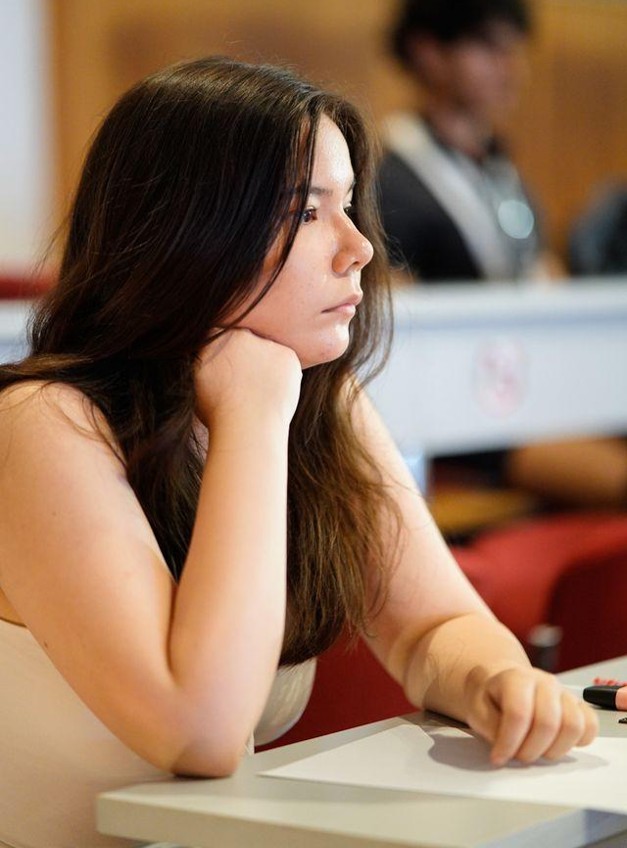
Her path wasn’t perfectly straightforward. She first attempted to qualify for the Economics Olympiad during her freshman year of high school but didn’t make it past the first round.” I knew almost nothing about economics,” she laughs. After transferring schools, the teacher responsible for extracurricular activities encouraged her to try again during her junior year. This time, older and better prepared, she advanced all the way to the international stage in Greece.
For her preparation, she relied on the foundation she had built through the International Baccalaureate Economics curriculum. Once she qualified internationally, Nurganym then supplemented her studies with EFI’s online learning materials and the book, Common Sense Economics.
When asked which parts of the Olympiad competition she enjoyed most, Nurganym immediately points to the policy evaluation questions. Rather than memorizing definitions, she enjoyed applying economics to real-world situations — evaluating fiscal policy, weighing tradeoffs, and recommending solutions based on a country’s economic circumstances. “Those applied problems were always my favorite,” she says.
This interest in applying theory to practical challenges has shaped her future ambitions as well. While she hasn’t decided exactly where her career will lead, she expects economics will remain central to it. She’s particularly interested in institutional economics and hopes to contribute to research on inequality and economic development. Although she is also considering public policy, she believes a strong theoretical foundation in economics will be valuable regardless of the direction she chooses.
Ultimately, Nurganym walked away from the competition with a silver medal. Winning at the Economics Olympiad itself happened so quickly that she barely remembers the moment. “Then I realized, ‘Oh wait… now I have to go on stage!’” she recalls. The victory was made even more memorable because it happened on her birthday.
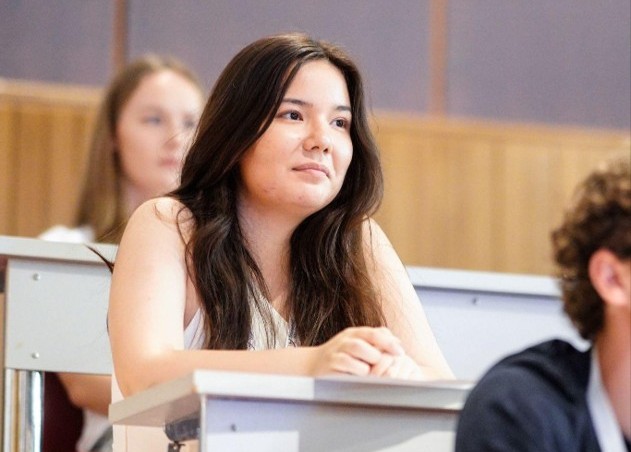
For Nurganym, however, the Economics Olympiad was about much more than competition. Her favorite memory was spending the final evening walking around Almaty with new friends from Uzbekistan and Kyrgyzstan at the EFI bootcamp. “It was really nice just talking to people from other countries,” she says. The friendships they formed have lasted well beyond the competition, and she still keeps in touch with two Ukrainian students she met in Greece.
One topic Nurganym speaks about with particular passion is encouraging more girls to study economics. When asked what advice she would give young women considering the field, her face lights up: “I love that question!” She notes that very few Nobel Prizes in Economics have been awarded to women, which can make the discipline seem intimidating.
“But don’t listen to anyone,” she says. “You don’t need a Y chromosome to study economics, to be great at economics, to teach it, to do research, or simply to study it for fun.” Her advice is simple: participate, ask questions, reach out to people, and don’t be afraid to learn.
She also encourages future Olympiad participants to make the most of the mentorship opportunities EFI provides. Looking back, she fondly recalls meeting with several professors through the bootcamp preparation. “They’re so willing to help,” she says. “They put together all these resources, organize everything, and genuinely want to mentor students. That’s what I’m most grateful for.”
For students in Kazakhstan wondering whether economics might be for them, her advice is refreshingly straightforward. “If you have even a little bit of interest, just try it,” she says. “Draw a few supply and demand graphs. Think about how they apply to the real world. You might discover it’s something you really enjoy.”
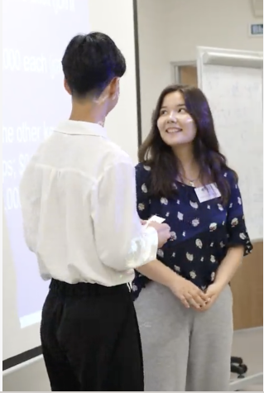
As she prepares to move from Kazakhstan to Connecticut, she’s looking forward not only to Yale’s classrooms and research opportunities but also to experiencing life in New Haven. Outside academics, Nurganym enjoys playing guitar, singing, spending time with her cat and watching Naruto, which she estimates she’s seen around ten times.
EFI is proud to celebrate Nurganym’s remarkable achievement and excited to see where her curiosity and passion for economics take her next!